

 Likes:
  Grammar:


So your perception that this is all on the up and up should be blindly accepted by everyone else. I see what you're saying. You're the voice that matters, because you're a . . . safe gun owner? Defining assault weapon or assault rifle are not relevant to the argument. It's a way to mislead the person you're arguing against into believing that they don't have all the facts, that their argument is wrong. It's coercive. The only difference between an M-16 and AR-15 is the name--public perception. That's what matters to you in this argument, not that both of them will put a round through someone's head just as easily as the other. That's the underlying truth of this argument that you're avoiding.Originally Posted by Condor

There is no reason for it. None at all.Of course I was speaking in terms of general gun ownership or self defense use. I don't know why they'd be carrying at the House of Representatives either, I'm guessing laws there are different, because where I live it would be illegal and not allowed.
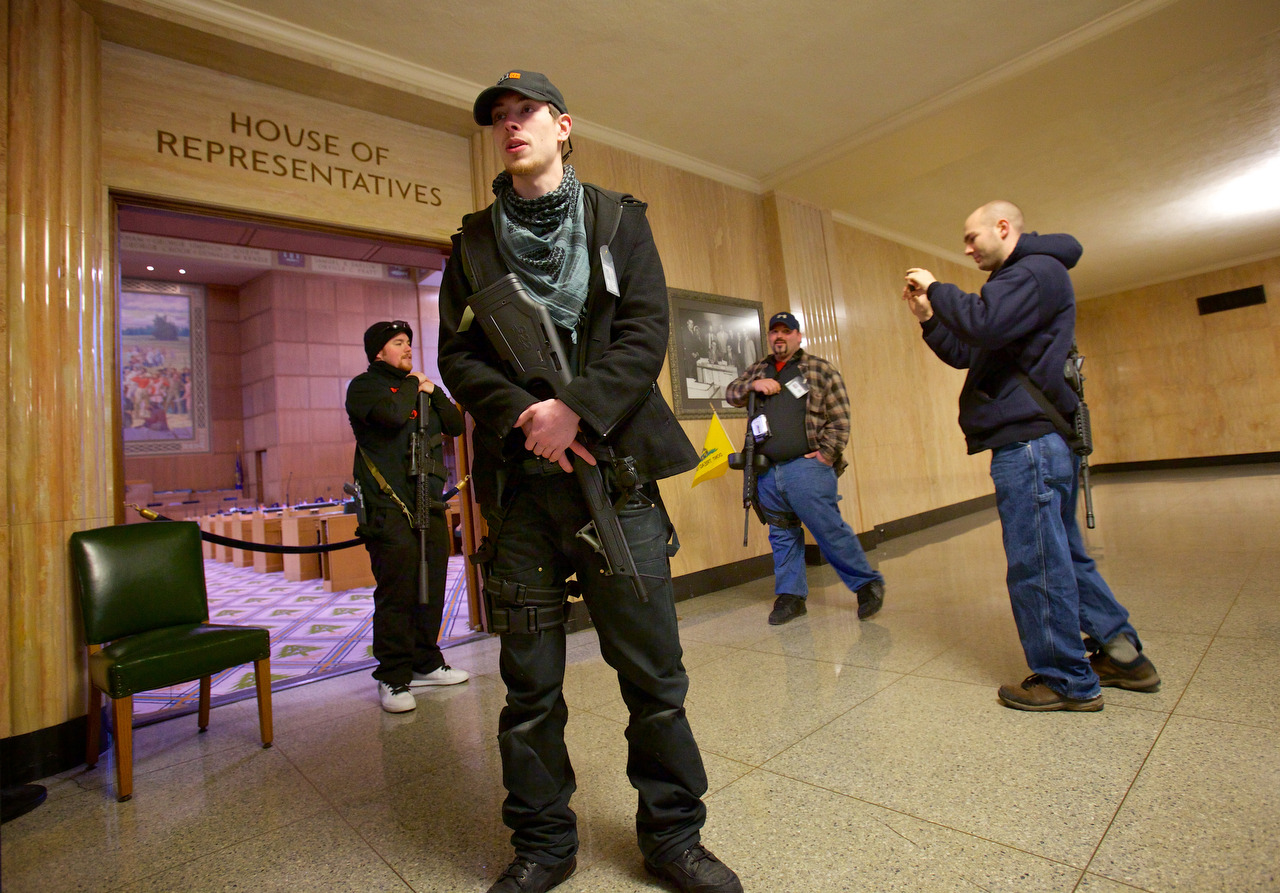
I thought I had made my position on that clearer. I'm not against concealed carry. I'm against citizens carrying unsafe firearms in public. I'll guess you don't put a trigger lock on your piece when you're out and about? I don't see locks on the weapons in the photograph. That makes it unsafe to the public in its vicinity. How? Anyone can take that weapon from you, and use it.Obviously, you seem to be against concealed carry. For the record I have a concealed carry permit and do indeed carry most of the time when I'm out. The only time I don't carry is when I know I'm going to a gun-free area. You said earlier (basically) that you feel a good guy with a concealed gun is just as dangerous as a bad guy with a concealed gun. We're just going to have to agree to disagree on that. I have a feeling nothing I say will change your mind on that, and I know knowing anyone says will change my mind.
With equal force. That's all. If someone tries to throw a punch at you, you throw one at them. Someone has a stick, you ok to have a stick. But if someone threatens you with a stick, are you saying it's ok to pull out your gun and shoot them? Because that's what it sounds like.Do you think a person has the right to defend themselves if they are attacked or threatened? I'm not specifically talking with a gun, could be your fist, a stick, or a knife.
Short answer no. Long answer, no I do not.Is it OK for someone to defend their life with a gun?
Should that gun be allowed for defense only when the person is at home?
What if a woman coming out of that local grocery store is grabbed in the parking lot, pulled into a van, where the bad guy tries to rape her?
Should she tell the rapist "please take me home so I can get my gun to defend myself" or should she pull out her concealed handgun and blow this scumbag's brains out?
What if a woman coming out of a local grocery store is followed through the parking lot, by a man. He follows her right to her driver's side door, she thinks he's reaching to grab her, drops her groceries, pulls out her piece, and shoots him. He dies because he parked beside her, and was putting his groceries on the front seat. She should tell his wife and kids, oh I'm so sorry, but I was certain he was about to attack me, and rape me. No, I don't think the average citizen really has the capacity to assess situations in moments of high stress with clear and rational thought. I really don't think most cops are able to. But I feel a lot safe around someone who has been professionally trained to deal with the stressful situations that you're choosing to exemplify.
So, your information is based on statistics from fellow gun advocates. Right.My source was primarily the link I posted (which notates the original sources of the info provided). I also got some of it from "NRA News Cam & Co" TV show and "Guntalk Radio" & "Downrange Radio" podcasts.
Again, I thought this was more clear. I'm not denying your right to OWN a gun. I believe every home should have a hunting rifle or a bow. What I don't advocate is citizens owning weapons that are easily converted to fully automatics. If these weapons weren't available to the general public, they wouldn't be on the streets in the hands of gang members, and criminals. That's a fact. I grew up around guns, I'm not a stranger to the world, and I'm not uneducated about firearms. I don't believe there is a need for semi-automatics to be made available to the general public.I wasn't trying to be snarky or an asshole either by asking the same question. I legitimately don't understand why someone else's right to NOT own a gun, if they choose, should override my right to own one. No one is being forced to own a gun if they don't want to. I have never heard of a pro-gun person or group trying to force someone to own a gun against their will. However, almost every anti-gunner tries to completely disarm legal gun owners against their will.
I'm not an "anti-gunner" as you call it. I'm against any average citizen carrying a weapon to an area where there isn't a firing range. I'm against any asshole walking past my kid's school with a pistol in the small of his back, or a rifle slung over his shoulder. I'm against any citizen taking a firearm into a building where the officials that I elect are trying to run my city, province, state, or country. That should be completely clear now.
Speculative based on personal and obvious political bias. But that's fine.That wasn't what I was saying exactly, but they do often report stories from a slanted perspective or edit footage to give the story a totally different meaning. I can think of 2 specific stories in the last couple weeks. I'll have to find those later for you, I've got to get to sleep for now.
CNN is just as bad as MSNBC if not worse. I don't watch any of the mainstream news programs as I don't trust them to be unbiased.
I've said all I'm saying on the matter. Feel free to carry on the great gun debate, as people have since the birth of black powder.
 Thanks: 0
 WAPoints: 0
Results 41 to 50 of 105
Thread: Fox News vs. mental stability
-
Feb 20th, 2013, 11:50 AM #41

 Ostentatious Legume

Status- Offline
Last edited by Osiris; Feb 20th, 2013 at 12:43 PM.
joint-point-counter-joint
-
Feb 20th, 2013, 01:01 PM #42Ostentatious Legume
Status- Offline
I'll say this:
Look, it's not a question of who is right, and who is wrong because the question isn't black and white, so how could the answer be. I think in theory many of the laws would work, I also think in theory time travel works--we know how that one figures out don't we? It will never matter how many facts are presented from either side, in the end it comes down to what is right for the individual. The principles are the same in both instances: understanding, respect, safety.
I want you to understand why I come from the position that I do, just as you want me to understand yours. We all want our positions to be respected. Safety is really the abstract here. It's a question of what makes someone feel safe, and what doesn't. How can one be safer than the other? Can you chose safety for someone else, and how do you determine for them what that looks like? Now, I'm not saying that you're doing for me--at least, I'm not intentionally steering us in that direction. I'm simply posing the question to us all. How do we determine what is safe?
Is a pistol behind three locks safer than one that isn't? At first glance I would argue that it is, in certain aspects. It is safer for a child. Is it presenting a safer environment all around? That's subjective; you have to factor in the human equation which is difficult enough on a good day.
Where do we draw the lines between what a safe weapon is and is not? Is a semi-automatic rifle safer to the public than a bolt action rifle? Again, is subjective and depends on the person behind the trigger. There are too many variables to consider, so how do we arrive at an answer to the first question: What is safe? I'm not asking the questions to challenge your knowledge, I'm asking the questions in the hope that instead of regurgitating statistics you will not only think for yourself, but think about something other than yourself.
So I pose a question to you all now.
How do we determine what is safe for everyone?joint-point-counter-joint
-
Feb 20th, 2013, 02:34 PM #43

 Blogger from the 9th Floor of the Tower
Status- Offline
Simply put: This is impossible. Any solution may get near to what one assumes to be "safe". And this highly depends on the point of view on the one hand and the outer circumstances on the other hand. Originally Posted by Osiris
To remain with guns and weapons: I would consider Germany or the EU safe, even compared with the US - and that although or because we have no legalized and free gun-ownership. And yet we have criminal activities in which guns are involved - either for threatening or even harming (killing) people. Compare with the overall situation those crimes are few in number, which is why I would say: They exist, but they don't make 'my place' an unsafe location - neither on the local in Saltgate (my town) nor up to the supranational territorical level of the EU.
That being said: Considering the News and reports about things happening overseas in the US I could say: the USA seem to be a fucking crazy and unsafe place; but the only things I see are reports about the really outstanding criminal events; this does not allow any judgement about the overall situation, which is why I feel inclined to say: even the USA, although or because gun-ownership is generally allowed, are a safe place to live in.
Now - which one is safer? And to what degree? I don't know. And actually I don't care.
All the best!
LiamZombie Story:
- raises the acceptance of killing humans in huge numbers,
- reveals everything bad and and even worse about human behaviour and psychology,
- is fun.
-
Feb 20th, 2013, 02:41 PM #44
 "Hunter"
Status- Offline
Join Date- Feb 2011
Location- Highlands, United Kingdom
Posts- 1,028
Achievements:


As many of you may know I side with Osiris. Its a logical rather than emotional/ ideological thing for me but thats irrelevant.
Back to the subject at hand.
I don't mind editorials, in fact they're essential to provoking debate. What gets me is when an item of news etc is presented as factual but is an opinion piece.
Often "Journalists" are guilty of manipulating the facts in order to support there own position on a topic.
There is no excuse for journalists mis-informing the public, especially when they are in a position of trust.
For example, how furious would you be if a teacher, whom a student is told is there to teach them facts was found to be actively promoting any religious doctrine?
If such a person tells a student God/Allah/Jehova created the universe then the student will base their world view around this, seeing it as a "Fact".
As Adults we often put our trust in journalists to relay facts and information around which we make decisions.
If we cannot do this how are we supposed to make informed decisions with regards to politics, finance etc?
Ideally newspapers/ programmes/ news sites would post a disclaimer at the start of the piece, ensuring that people are informed they are consuming an opinion piece.
Not nearly enough new sources etc adopt easily accessible ethics policies. The only example i know of is a games site known as Polygon.
It is also disappointing how much influence big business have on papers. Monopolies such as the Murdoch empire should, in my belief, be broken up ensuring journalistic independence and integrity.
I absolutely don't support Govt' regulation of the press (there is nothing more dangerous to our freedoms) but I'm a big advocate of independent regulators whom are answerable to the public.
-
Feb 20th, 2013, 02:42 PM #45Blogger from the 9th Floor of the Tower
Status- Offline
Besides:
A discussion about "safe" or "what is safe" requires a definition of "safe/ safety" everyone would agree on. And this is probably not as easy as it may seem on first sight ...Zombie Story:
- raises the acceptance of killing humans in huge numbers,
- reveals everything bad and and even worse about human behaviour and psychology,
- is fun.
-
Feb 20th, 2013, 03:37 PM #46Ostentatious Legume
Status- Offline
I disagree with the highlighted text. It is entirely relevant to the topic! In fact, that's exactly what we're discussing! Originally Posted by Solanine
joint-point-counter-joint
-
Feb 20th, 2013, 03:43 PM #47Ostentatious Legume
Status- Offline
Do you think that the media plays too big a part in how we form our perceptions of the worlds overseas? I'm sure that a lot of Americans would disagree with the general perception is that they live in a violent culture, as many South Africans would say the same. We're given access to so much in first world countries, but we're still viewing it all through the coloured lenses of generic media outlets. I can see it being difficult to build better-informed idealogical structures that are based in logic and fact as opposed to fear and misinformation. Originally Posted by LiamKerrington
joint-point-counter-joint
-
Feb 20th, 2013, 03:44 PM #48
 Mofo with the Mojo
Status- Offline
Join Date- Mar 2012
Location- Mysterical Island, Va.
Posts- 2,070
Achievements:


Originally Posted by YetAnotherBloodyCheek
Originally Posted by reaper239
Ooo, ooo, ooo!!! What if they were wearing Turbans?
Call Sign: Jive Turkey
Ladies and Gentlemen, straight from Mysterical Island, it's the Shaman of Schiznick, the Mofo with the Mojo, the Mad Scientist of the Jungle, the Doctor is in!
Doctor? Doctor who?
NO! Witch Doctor, fool!
-
Feb 20th, 2013, 04:51 PM #49Ostentatious Legume
Status- Offline
Interesting, but I think we all know the answer to that. They would have been gunned down in a hail of bullets. Touchy subject, but sure. What effect does race, and religion have on all of this? I feel equally ill-at-ease with the "good ol' boys" in this photo as I would if they were any other color. I think public opinion would be vastly different. Those people standing up and saying, "My fucking gun rights," would be saying, "The fuck are those guys doing with guns there!? That's some bullshit!" Originally Posted by Witch_Doctor
joint-point-counter-joint
-
Feb 21st, 2013, 02:18 AM #50Blogger from the 9th Floor of the Tower
Status- Offline
This is a very good question. But before I get down on this one, let me first focus on a small detail: Originally Posted by Osiris
Media and news are two different things. And both have different tasks, and if not task, they both aim at different goals they try to achieve.
The News Services focus on most recent events or current questions which are or are to be discussed in the public - like for instance: guns, gun-ownership, gun-control. The News provide information about the facts on the one side, while each News Service connects the facts with a certain opinion or tendency of opinion. They do this with a couple of different types of articles and with different methods of filtering information - just reporting mere facts, commentary on matters, prolonged reports, interviews with specialists or involved people, polls, and prior to all of this: selection and prioritization of topics, nomally based on the decisions of the editor or a group of editors.
The Media has a very different approach. They don't necessarily stick with recent events on the one side. And also they are not limited to the tools of trade like the News are. The Media, actually, is much more broader then the News with the News being one part of what the Media provides as one of many different services. Other services include documentaries, talk shows with major topics, reviews of what other services of different types have discussed, movies and TV-shows; and doing all these things, that allows them to delve much deeper into any topic then what the News-Services can ever achieve. But there are a few similarities nevertheless: The Media itself governs what they want to show and how they want to get involved in certain topics, and the major decisions are again made by top-editors.
Now, why this distinction? Simple: While I mentioned earlier that the News are very much focussed on displaying criminal and violent assaults and thus on providing only a very small fraction of what is going on in the USA, the Media does not do this. The Media provides much more different content regarding the USA - about culture, society, politics, economy, sciences, 'the land' or 'the nation' in general allowing the audience to get a much broader and thus much better, though still to some degree filtered picture about the USA; but the USA is not reduced to a gun-crazy nation, like what we receive from the News. The focus here therefore is on The News-Services and not so much on Media in general.
But this judgement about the News-Services in Germany or the EU in relation to the events taking place in the USA is only half true; because the News also provide a lot of information about current events in the USA like what the President of the USA does, what political tensions on certain matters exist, what economy does, what other natural hazards take place, what crazy or impressive sport-events happen etc. The interesting thing, though, is that the emotional impact is much bigger and harder to digest, when the News give a report about one/ few madmen shooting in a frenzy and killing many people without any cause; and here, actually, it does not even matter if any News Service does so in an opinionated way. And such News shape the opinion about the USA much stronger then any other News - which is, actually, weird. Theory: And I think this happens because the foreign audience automatically compares their tradition and situation with what - according to the News - seems to be the case in the USA; and since such violent acts have a much more personal feel to them, I think, the members of the audience feel much more touched to it - like based on a certain 'social empathy' or something ... (I hope this makes some sense, what I write here ...)
Having said all this: This does not only apply to the situation between foreign News Services and events in the USA; this seems to be true for national News and the current events within the same nation.
Therefore the question would be: Is anything wrong with the way News-Services filter news and choose the method of displaying news?
All the best!
LiamZombie Story:
- raises the acceptance of killing humans in huge numbers,
- reveals everything bad and and even worse about human behaviour and psychology,
- is fun.

 Reply With Quote


 Posting Permissions
- You may not post new threads
- You may not post replies
- You may not post attachments
- You may not edit your posts
Bookmarks